FlowTex Composite CF100
Published properties, selection guidance and a downloadable reference sheet for FlowTex Composite CF100.
Read moreHome/FlowTex Dewatering Technology • Manufactured in South Africa
A fine-filtration nonwoven liner inside a structural woven shell, manufactured for the actual slurry and project geometry.
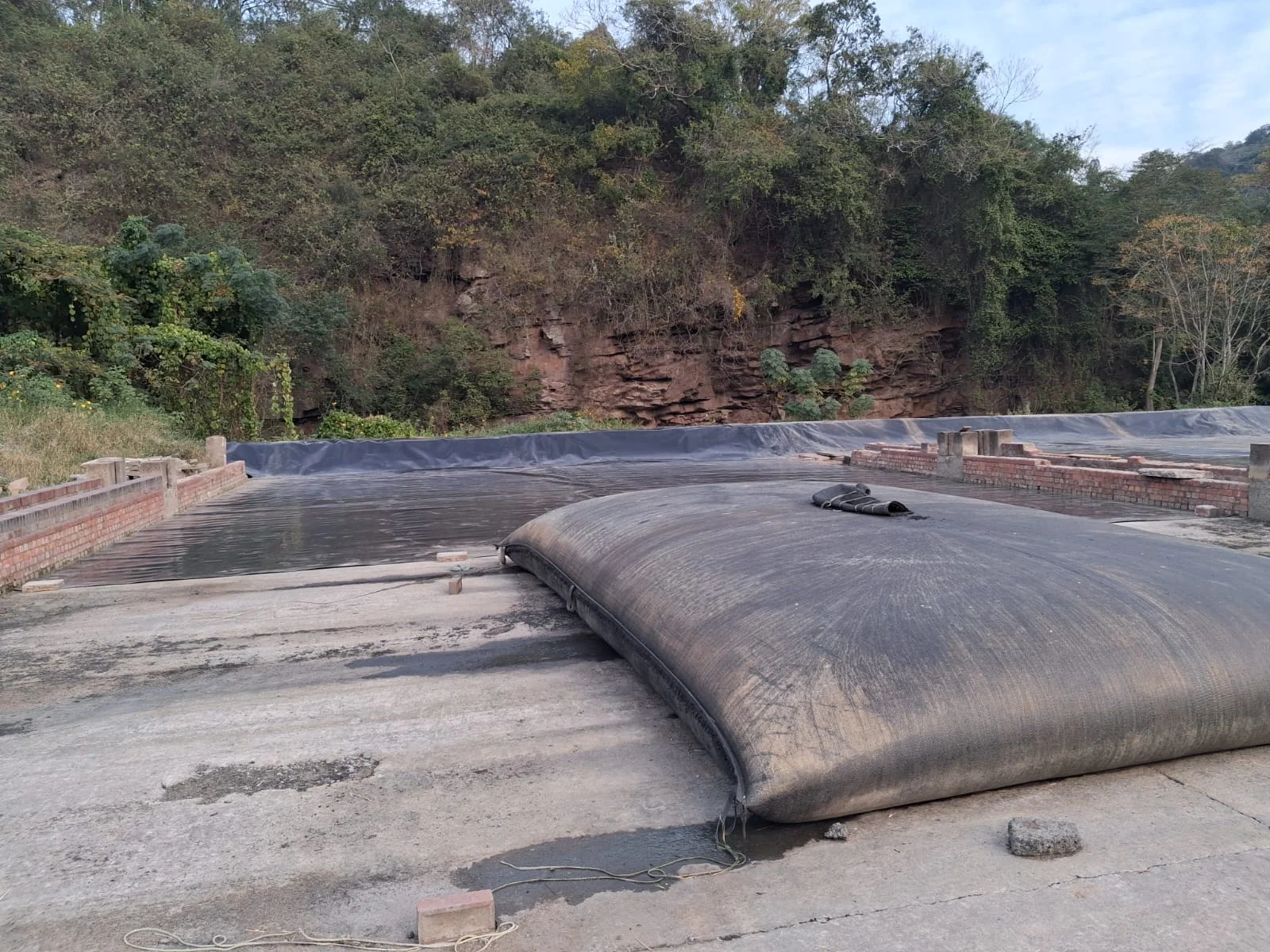
Composite Dewatering Bags & Tubes
The inner liner provides a separate filtration interface; the woven outer enclosure provides the structural shell. Our composite selection considers both layers, the seams and ports, and their combined drainage behaviour.
Specifications & solutions
Published properties, selection guidance and a downloadable reference sheet for FlowTex Composite CF100.
Read morePublished properties, selection guidance and a downloadable reference sheet for FlowTex Composite CF95.
Read morePublished properties, selection guidance and a downloadable reference sheet for FlowTex Composite CF90.
Read morePublished properties, selection guidance and a downloadable reference sheet for FlowTex Composite CF85.
Read moreProduct selection
Compare the published grades, then confirm the supplied construction and project requirements in the technical submission.
| FlowTex liner | O90 (µm) | Normal permeability (mm/s) | Tensile MD/CD (kN/m) | Mass (g/m²) | CBR puncture (kN) |
|---|---|---|---|---|---|
| CF100 | 100 | 85 | 16 / 16 | 200 | 2.35 |
| CF95 | 95 | 70 | 20 / 20 | 250 | 3.00 |
| CF90 | 90 | 55 | 25 / 25 | 300 | 3.85 |
| CF85 | 85 | 55 | 30 / 30 | 385 | 4.50 |
Properties of the inner continuous-filament polypropylene nonwoven only, not the assembled composite. O90: EN ISO 12956; normal permeability at 50 mm head: EN ISO 11058; tensile: EN ISO 10319; mass: EN ISO 9864; CBR: EN ISO 12236. Values are indicative averages. Outer-shell and liner strengths must not be added. Verify the complete assembly in trials.
| FlowTex grade | Tensile MD/CD (kN/m) | O90 (µm) | Normal permeability (mm/s) | Mass (g/m²) |
|---|---|---|---|---|
| HF45 | 45 / 45 | 600 | 40 | 210 |
| HF60 | 60 / 60 | 600 | 27 | 280 |
| HF105 | 105 / 105 | 300 | 25 | 500 |
Nominal reference fabric values, subject to stated tolerances and the current project submission. Tensile: EN ISO 10319; O90: EN ISO 12956; normal permeability: EN ISO 11058; mass: EN ISO 9864. Fabric strength is not seam strength or allowable filling pressure.
| Dimension | How to specify it |
|---|---|
| Maximum stated fabrication size | Up to 15 m circumference × 30 m finished length |
| Lay-flat width at 15 m circumference | Approximately 7.5 m before seam allowances; not filled width |
| Circular-equivalent diameter at 15 m circumference | Approximately 4.77 m; a geometric reference, not operating height |
| Working capacity | Determined from filled geometry, allowable height, slurry density and consolidation |
| Ports and connections | Specify diameter, quantity, spacing, hose connection and filling sequence |
| Handling | State pad-based emptying or a separately designed and validated lifting duty |
Capability confirmed by FlowTex management. Availability of any size/fabric combination is subject to fabrication review. The maximum dimensions are not a guaranteed working volume, pump rating or approval to stack or lift.
From specification to site
Use the 100 µm liner as the initial balanced candidate for trials. Its reference normal permeability is 85 mm/s and its mass is 200 g/m². These are liner properties, not a composite throughput guarantee.
Evaluate the 85 µm liner where trials show a need for tighter filtration or a more robust inner layer. It has reference normal permeability of 55 mm/s and mass of 385 g/m². It does not guarantee retention of all particles above or below 85 µm.
CF95 and CF90 allow further trial comparisons. Choose the construction that meets filtrate and drainage targets at acceptable cake formation and operating cost.
Compare liner and outer-shell interaction, folding, seam details, port transitions and filling cycles. Do not add the two tensile strengths or assume two filter layers halve the opening size.
FAQ
FlowTex holds stock for immediate supply. Ask for the available grade, dimensions and quantity; allocation is confirmed for the order. Custom dimensions or a different construction require a fabrication programme. Dispatch readiness and delivery time are confirmed separately.
Start by trialling CF100 as the balanced candidate and CF85 where a tighter opening is required. Compare the actual feed, conditioning, early filtrate, drainage and cake formation. Neither is universally best.
No. The assembled composite needs its own structural and hydraulic assessment. The inner-liner values describe that layer only.
Send the feed, volume, filtrate target, dimensions, location and programme. We will help define the next step.