Monofilament Dewatering Tubes
South African manufacture and Africa-wide project supply, with fabric selection, dimensions and operating requirements matched to your slurry.
Read moreHome/FlowTex Dewatering Technology • Manufactured in South Africa
Custom dewatering tubes for repeated filling, drainage and consolidation. Up to 15 m circumference × 30 m length, with project-specific fabrication.
Geotextile Dewatering Tubes for Africa
Use project-scale tubes where the slurry campaign, available pad and solids-removal programme call for larger containment. Size the installation around dry-solids loading, trialled cake behaviour, working geometry and the filling/drainage schedule.
Specifications & solutions
South African manufacture and Africa-wide project supply, with fabric selection, dimensions and operating requirements matched to your slurry.
Read moreSouth African manufacture and Africa-wide project supply, with fabric selection, dimensions and operating requirements matched to your slurry.
Read moreA fine-filtration nonwoven liner inside a structural woven shell, manufactured for the actual slurry and project geometry.
Read moreEstimate dry-solids loading and cake volume; use approved unit capacity and quoted inputs for indicative counts and supply cost.
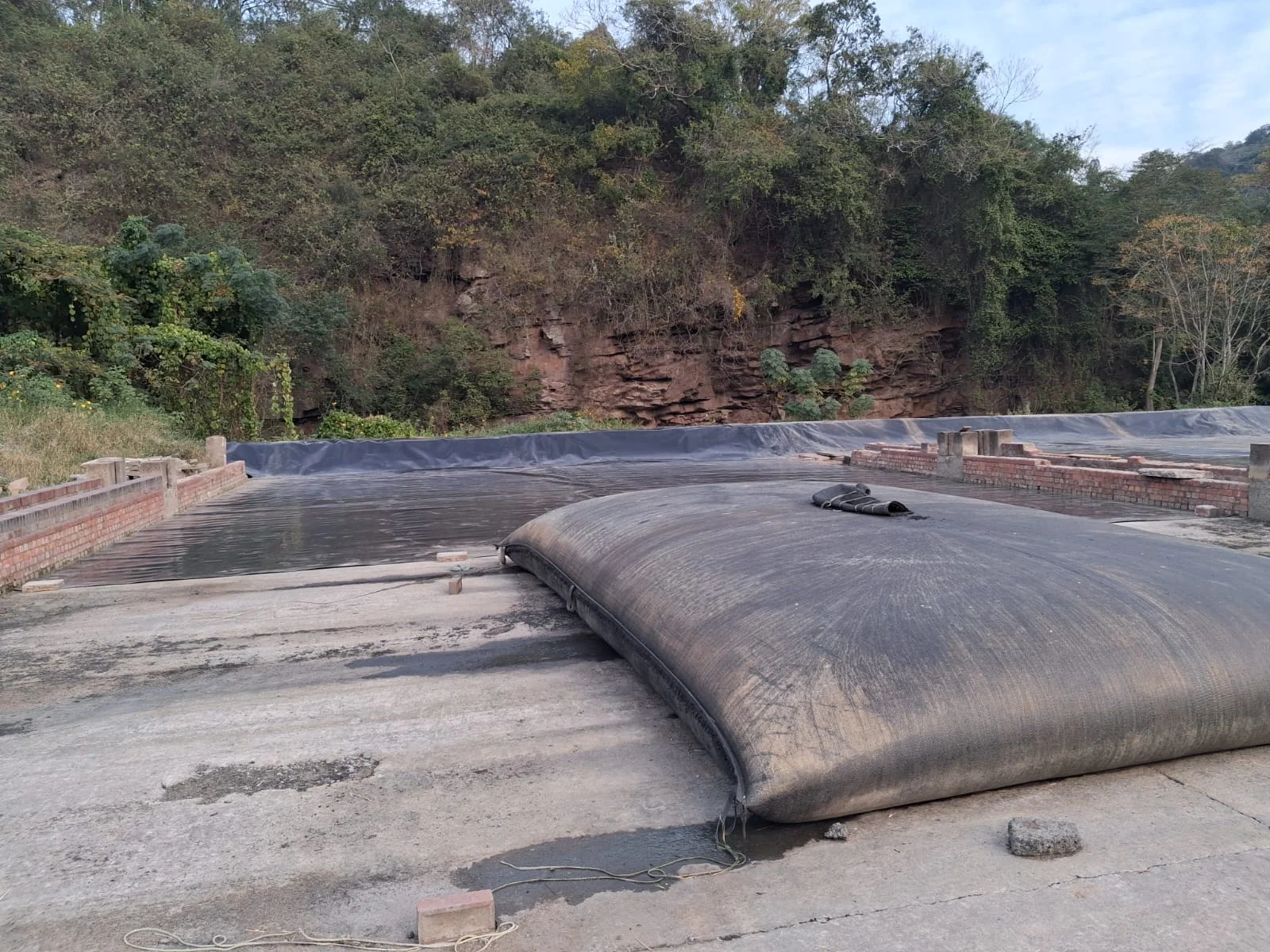
Read moreTen custom monofilament tubes, a lined working area and a planned drainage arrangement on one South African project.
Read moreProduct selection
Compare the published grades, then confirm the supplied construction and project requirements in the technical submission.
| FlowTex grade | Polymer | O90 (µm) | Normal permeability (mm/s) | Tensile MD/CD (kN/m) | CBR puncture (kN) |
|---|---|---|---|---|---|
| Mono 180 | PP | 180 | 50 | 40 / 40 | 6 |
| Mono 350 | PE | 350 | 300 | 44 / 35 | 4 |
| Mono 600 | PE | 600 | 350 | 41 / 35 | 3.5 |
Reference fabric averages. O90: EN ISO 12956; normal permeability: EN ISO 11058; tensile: EN ISO 10319; puncture: EN ISO 12236. Not finished-bag pressure, throughput or lifting ratings. O90 is not an absolute particle cut-off.
| FlowTex grade | Tensile MD/CD (kN/m) | O90 (µm) | Normal permeability (mm/s) | Mass (g/m²) |
|---|---|---|---|---|
| HF45 | 45 / 45 | 600 | 40 | 210 |
| HF60 | 60 / 60 | 600 | 27 | 280 |
| HF105 | 105 / 105 | 300 | 25 | 500 |
Nominal reference fabric values, subject to stated tolerances and the current project submission. Tensile: EN ISO 10319; O90: EN ISO 12956; normal permeability: EN ISO 11058; mass: EN ISO 9864. Fabric strength is not seam strength or allowable filling pressure.
| Dimension | How to specify it |
|---|---|
| Maximum stated fabrication size | Up to 15 m circumference × 30 m finished length |
| Lay-flat width at 15 m circumference | Approximately 7.5 m before seam allowances; not filled width |
| Circular-equivalent diameter at 15 m circumference | Approximately 4.77 m; a geometric reference, not operating height |
| Working capacity | Determined from filled geometry, allowable height, slurry density and consolidation |
| Ports and connections | Specify diameter, quantity, spacing, hose connection and filling sequence |
| Handling | State pad-based emptying or a separately designed and validated lifting duty |
Capability confirmed by FlowTex management. Availability of any size/fabric combination is subject to fabrication review. The maximum dimensions are not a guaranteed working volume, pump rating or approval to stack or lift.
From specification to site
Define feed flow and variability, dry-solids mass, cake condition and operating programme. Plan simultaneous units and filling/draining cycles with access and filtrate collection.
Confirm circumference, finished length, fabric direction, seams, port diameter/count/spacing and allowable filling limits. The fabrication envelope extends to 15 m circumference × 30 m length, subject to assembly review.
Review foundation, protection, drainage and collection with the filled layout. Stacking requires a separate stability and construction-sequence assessment; HF105 fabric alone does not approve it.
Confirm when and how consolidated solids will be removed, transported or retained. Include access, weather and maintenance in the campaign layout.
FAQ
Establish dry-solids load and target cake volume, then use a verified working capacity for the proposed assembly and campaign schedule. The sizing estimator can organise these inputs; it does not determine structural capacity from circumference.
Repeated filling and drainage may be used within the approved operating procedure. Residual cake reduces available capacity and each cycle needs inspection and filling control.
Not on the strength of the fabric label. Stacking needs a separate foundation, stability, drainage and filling-sequence assessment for the actual layout.
Send the feed, volume, filtrate target, dimensions, location and programme. We will help define the next step.